Models
Brands
Body Types
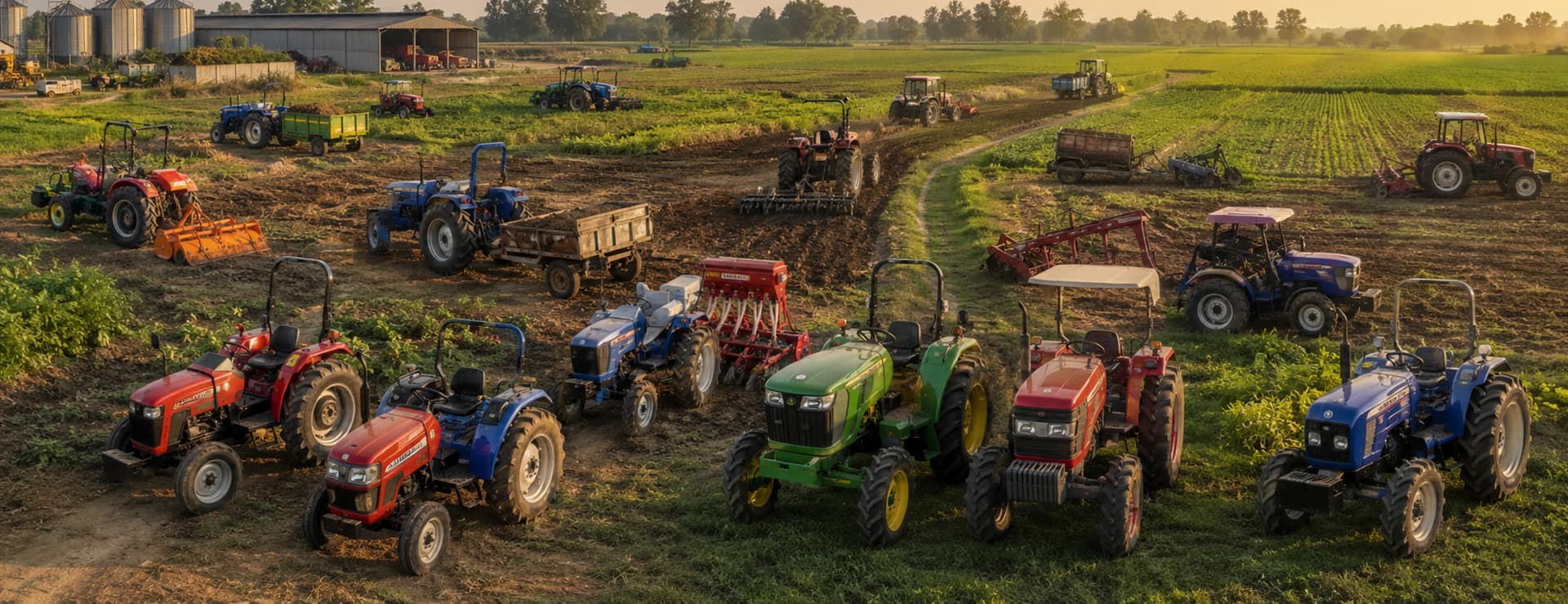
A tractor is the primary agricultural workhorse used across farming operations like ploughing, soil cultivation, sowing, spraying, and heavy hauling. By attaching different implements such as rotavators, cultivators, disc ploughs, seed drills, and trailers, a single tractor handles multiple farming and transport jobs throughout the crop cycle.
Choosing the right tractor depends on your total land area, soil type, crops grown, required horsepower (HP), and the specific implements you plan to run. This makes an agricultural tractor useful for a wide range of farming requirements. Safe towing capacity depends on the tractor’s engine horsepower, low-end torque, and axle strength, making it important to match the vehicle's capacity with your daily haulage requirements.
The history of mechanized farming dates back to the early 1900s. In 1904, Benjamin Holt developed a successful track-type tractor in California, USA, replacing traditional wheels with continuous tracks to prevent sinking in wet, soft soil. In India, local manufacturing reached a landmark moment in 1959 when Eicher began producing tractors at its Faridabad plant, helping lay the foundation for India's modern agricultural industry.
Today, Indian farmers and commercial operators can choose from a wide range of HP categories, drive types (2WD/4WD), and specialized configurations built for diverse farming and transport duties. On GadiyaHub, you can explore tractors across 2+ body types, 20+ leading brands, and 363+ models, making it easy to filter and compare options based on your budget, acreage, horsepower requirements, and farm implements.
Agricultural tractors are categorized by body structure and chassis size to suit different farm sizes, orchard layouts, and duty levels:
Standard Tractors: Standard, full-sized machinery spanning broad horsepower ranges handles the most demanding agricultural chores. From deep soil ploughing and seedbed tilling to pulling heavy trailers and running PTO-driven implements, these builds serve as a dependable farm tractor for routine, heavy-duty field work.
Mini Tractors: Compact tractors specially engineered for small landholdings, orchards, vineyards, and narrow inter-crop fields. Their smaller footprint and tight turning radius allow easy maneuvering where full-sized tractors cannot fit, making them budget-friendly for light cultivation, crop spraying, inter-cultivation, and daily farm chores.
Selecting the right tractor model depends entirely on your daily agricultural activities, field size, and soil conditions. Before making a purchase decision, evaluate how a tractor performs across key farming and logistics duties:
Field Preparation: Tractors work with heavy implements like disc ploughs, cultivators, and rotavators (rotary tillers) to break up hard soil, clear stubble, and prepare smooth seedbeds before planting.
Sowing & Planting: Connected to seed drills, planters, or transplanters, tractors ensure seeds and fertilizers are deposited at uniform depth and row spacing for maximum crop yield.
Orchard & Vineyard Farming: Compact mini tractors excel in narrow orchard lanes, fruit gardens, and vineyard rows where full-sized tractors cannot turn or fit.
Paddy & Wet-Field Cultivation: Specially fitted tractors with mud tyres or cage wheels perform puddling operations in waterlogged paddy fields, preparing the soil for rice transplantation.
Crop Management & Protection: Equipped with boom sprayers or power dusters, tractors help farmers apply fertilizers, pesticides, and liquid crop-protection treatments evenly across large acreages.
Farm Transport & Haulage: Paired with a heavy-duty trolley or trailer, a tractor transports harvested crops, seeds, animal feed, and farm equipment smoothly between fields, storage godowns, and local mandis.
Heavy Agricultural & Commercial Duty: High-horsepower (HP) tractors (45 HP and above) handle demanding farming jobs, pulling heavy multi-bottom ploughs, large balers, laser land levellers, and commercial trailers.
The true versatility of an agricultural tractor lies in its ability to connect with specialized tractor farm equipment. To ensure efficient operation without overloading the engine, always match the implement with your tractor’s horsepower (HP), Power Take-Off (PTO) output, hydraulic lifting capacity, and 3-point hitch linkage:
Rotavator (Rotary Tiller): Uses rotating blades to break soil clods, pulverize the topsoil, and level the seedbed in a single pass, preparing fields for quick planting.
Cultivator: Loosens and aerates the upper soil layer, uproots weeds, and prepares the field between crop cycles while preserving soil moisture.
Plough (Disc & Mouldboard Plough): Designed for primary, deep-soil tillage, turning over hard ground and burying crop residue to open up previously uncultivated land.
Seed Drill: Mechanizes the sowing process by planting seeds and applying fertilizer simultaneously at uniform soil depths and row spacing.
Tractor-Mounted Sprayer: Utilizes the tractor's PTO or hydraulic system to power liquid spray booms, distributing pesticides and liquid fertilizers evenly across large crop fields.
Tractor Trolley & Trailer: Essential for agricultural transport, enabling heavy hauling of harvested produce, fertilizers, crop stubble, and equipment between fields and local markets.
Reaper & Harvester Attachments: Front- or rear-mounted crop reapers help automate harvesting for crops like wheat and paddy, reducing labor dependency during peak harvest seasons.
Tractor prices in India vary depending on engine horsepower (HP), drive type (2WD or 4WD), hydraulic lifting capacity, advanced features, brand reputation, and specific model variants. GadiyaHub organizes tractors across distinct budget ranges to help you find options that match your farm size and financial plan, whether you plan to buy a tractor for small-scale farming or larger agricultural operations:
Tractors Under Rs. 3 Lakh: Includes entry-level compact and mini tractor models built for small plots and light farm duties. Notable examples include the Captain 200 DI listed around Rs. 3 lakh.
Tractors Between Rs. 3-5 Lakh: Features lower-HP standard tractors and high-utility mini tractors. Popular options include the Swaraj 717, Eicher 242, and Sonalika DI 730 III.
Tractors Between Rs. 5-8 Lakh: The most popular price bracket for mid-range agricultural tractors handling general farming and haulage. Models available on GadiyaHub include the Mahindra 265 DI SP Plus, Eicher 380, and New Holland 3630 TX Super.
Tractors Between Rs. 8-10 Lakh: Covers higher-horsepower tractors engineered for heavy tillage, larger implements, and continuous commercial transport. Examples include the Swaraj 855 FE and select variants of the Swaraj 744 FE.
Tractors Between Rs. 10-15 Lakh: Features premium high-HP tractors, multi-axle heavy haulers, and advanced 4WD platforms designed for heavy agricultural machinery and large-scale farming operations.
Note: Final tractor prices vary by state RTO taxes, insurance, dealer location, accessories, and local subsidies. Buyers should always verify current ex-showroom and on-road prices in their region before finalizing a purchase.
Fuel selection directly impacts heavy pulling power, daily running costs, and engine maintenance across farming operations:
Diesel Tractors: Diesel remains the dominant fuel choice across the agricultural tractor market. Diesel engines produce strong pulling power even at low engine speeds, making them ideal for heavy ploughing, soil tilling, and trolley haulage across all horsepower (HP) ranges.
Popular Tractor Brands in India
India’s agricultural market features several well-known manufacturers, including Mahindra, Swaraj, Farmtrac, Eicher, Sonalika, Powertrac, Preet, John Deere, and Massey Ferguson.
These are among the major tractor brands in India available to farmers.
Each brand offers tractors across different HP ranges and applications, so brand name alone should not be the only factor when selecting a tractor. The specific model, overall specifications, implement compatibility, and your own regional farm requirements matter just as much during final evaluation.
Popular Tractor Models in India
Farmers searching for widely trusted tractor models can explore options such as the Eicher 485, Eicher 242, Mahindra 265, Swaraj 855, Swaraj 744, Massey Ferguson 1035 DI, John Deere 5055, and Sonalika DI 35.
However, a tractor model being popular does not mean every variant of that model will suit your exact needs or have the same demand. Different variants come with different engine outputs, drive options (2WD or 4WD), features, and price tags. For instance, the Swaraj 744 FE is available in both 2WD and 4WD options, with each configuration priced and equipped differently.
On GadiyaHub, users can open individual tractor model pages to check available variants, detailed specifications, prices, images, and full product lists to see which exact configurations are available for purchase.
Choosing the right tractor involves looking beyond the brand name or upfront price tag. Evaluating core technical specifications helps ensure the tractor matches your soil type, land size, and daily farming workload:
Engine Horsepower (HP): Determines the tractor's overall engine capacity. Lower HP models suit light cultivation and small farms, while higher HP tractors are required for heavy-duty tillage, deep ploughing, and commercial haulage.
PTO Horsepower (PTO HP): Power Take-Off (PTO) output measures the actual power transferred to run rotating implements like rotavators, thresher sprayers, and balers. Always verify the required PTO HP of your implements before buying.
Engine Torque & Pulling Power: High low-end torque provides the heavy pulling force needed to drag heavy implements through hard soil or haul loaded trolleys without stalling the engine.
Hydraulic Lifting Capacity: Indicates the maximum weight the rear 3-point linkage can lift. A higher lifting capacity is necessary for operating heavy rear-mounted implements like multi-bottom ploughs, seed drills, and laser levellers.
Drive Type (2WD vs 4WD): Two-Wheel Drive (2WD) tractors are cost-effective for regular dry-land farming and transport. Four-Wheel Drive (4WD) tractors offer superior traction, preventing tyre slippage in wet paddy fields, muddy tracks, and steep inclines.
Transmission Type & Gear Options: Gearbox configurations (like Constant Mesh or Synchromesh) impact driving ease, speed control, and field efficiency across diverse agricultural operations.
Farm Size & Primary Application: Match the tractor’s dimensions and power range to your specific farming conditions, whether it is smallholding crop farming, orchard inter-cultivation, wet paddy puddling, or long-distance trolley transport.
Fuel Efficiency & Running Costs: Since tractors operate for long continuous hours during peak seasons, choosing an engine tailored to your actual workload helps control daily fuel expenses.
Ground Clearance: High ground clearance protects the undercarriage on rough terrain, deep field ridges, and uneven farm tracks, preventing crop damage during inter-cultivation.
Fuel Tank Capacity: A larger fuel tank allows for extended operating hours in distant fields, minimizing time lost to frequent refueling stops during busy harvest seasons.
Maintenance & Spare Parts Support: Check routine service intervals, replacement part prices, and local mechanic familiarity to avoid costly downtime when field work is time-sensitive.
Dealer Network & Local Support: A well-established dealership network ensures easy access to genuine spare parts, quick technical support, and routine servicing. You can use GadiyaHub’s dealer directory to locate nearby tractor showrooms instantly.
Resale Value & Market Demand: A tractor’s second-hand value depends on its running condition, total hours clocked, maintenance history, and local regional demand. Evaluate the resale popularity of the specific model and variant rather than relying solely on brand reputation.
GadiyaHub helps you compare tractors based on budget, brand, horsepower (HP), and farm workload. Comparing models side-by-side helps you easily evaluate engine specs, PTO power, hydraulic lifting capacity, 2WD or 4WD options, and final pricing.
You can check tractor images, model specifications, variant lists, estimated EMI options, and nearby authorized tractor dealers. Real owner reviews also give you practical insights into fuel mileage and long-term maintenance.
GadiyaHub offers a fast way to find the right tractor for your budget and field requirements, including suitable agricultural tractor equipment for different farming needs.
Ex-Showroom
Ex-Showroom
Ex-Showroom
Ex-Showroom
Ex-Showroom
Ex-Showroom
Ex-Showroom
Ex-Showroom
Ex-Showroom
Ex-Showroom
Ex-Showroom
Ex-Showroom
Ex-Showroom
Ex-Showroom
Ex-Showroom
Ex-Showroom
Ex-Showroom
Ex-Showroom
Ex-Showroom
Ex-Showroom
