Models
Brands
Body Types
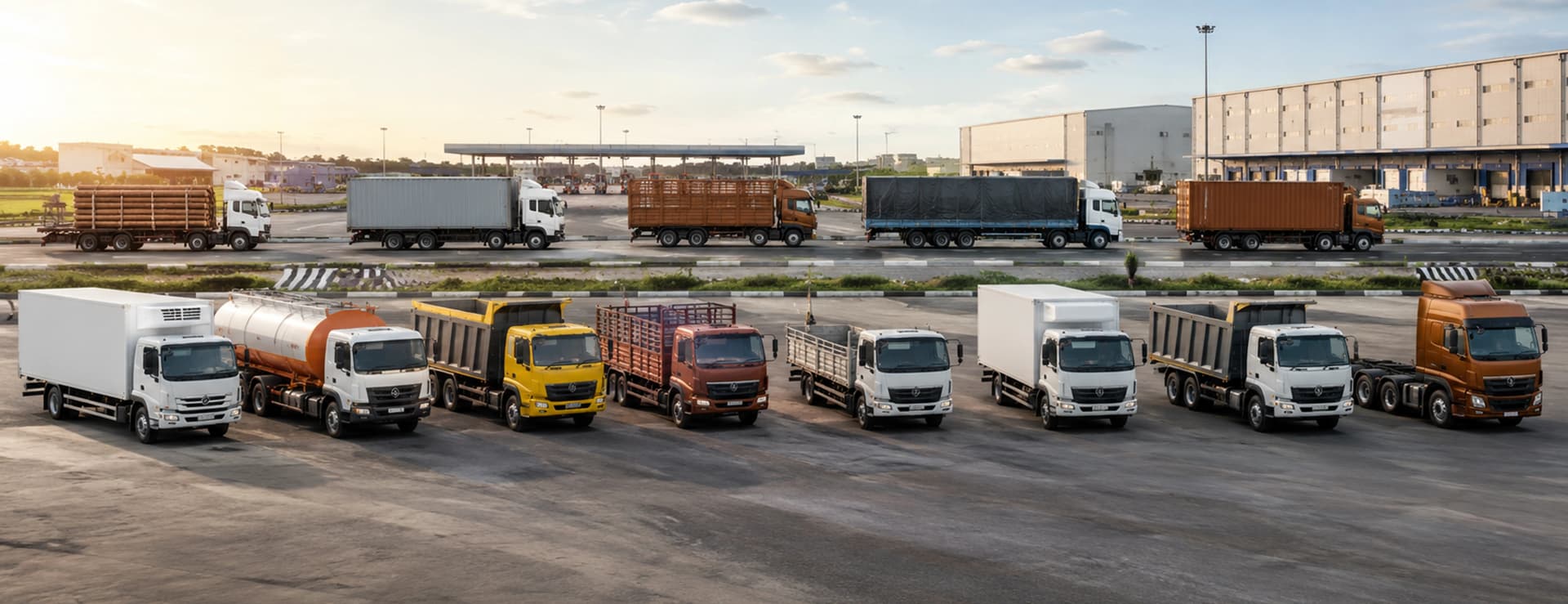
Commercial vehicles in India form the backbone of modern logistics and business supply chains, built specifically to transport goods, raw materials, heavy equipment, and passengers. From last-mile delivery mini-trucks to massive multi-axle tippers, commercial trucks, haulage trucks, and tractor-trailers, these machines are engineered around specific payload capacities, route demands, and heavy-duty applications.
The history of commercial transport dates back to 1896, when Gottlieb Daimler built the world's first motorized truck in Germany. The journey of commercial automotive in India reached a major turning point in 1954, when TELCO (now Tata Motors) partnered with Daimler-Benz to produce Tata-Mercedes-Benz trucks in Jamshedpur, a move that laid the foundation for India's modern Goods and transport industry.
Today’s transport operators and fleet owners can choose from a wide range of body types, fuel options, payload limits, and Gross Vehicle Weight (GVW) ratings.
On GadiyaHub, you can explore commercial vehicles across 8+ body types, 7+ leading brands, and 269+ models to find the ideal match for your operational needs, route conditions, and business budget.
Commercial body configurations are engineered to solve distinct cargo and logistics challenges. Understanding these core body styles helps you pick the right vehicle for your daily operations:
HCV (Heavy Commercial Vehicle): Engineered for maximum payload capacity and demanding long-haul transport. These heavy commercial vehicles dominate interstate logistics and bulk cargo movement.
LCV (Light Commercial Vehicle): Strikes an ideal balance between cargo volume and maneuverability. LCVs are widely used by regional distributors and medium-scale businesses for city-to-city transport. Buyers can also explore the LCV vehicle list in India to compare available options.
SCV (Small Commercial Vehicle): Compact cargo carriers designed for light loads, dense urban traffic, and fast last-mile deliveries right to the customer's doorstep. These small commercial vehicles are commonly used for local goods movement.
Haulage: Built specifically for continuous, long-distance freight movement. Haulage trucks come in rigid and multi-axle setups depending on route and cargo weight.
ICV (Intermediate Commercial Vehicle): Positioned directly between light and heavy commercial segments, ICVs offer increased payload room for regional operators needing more capacity than a standard LCV.
Tractor Trailer: High-capacity articulated units designed for pulling heavy shipping containers, industrial machinery, and bulk goods over national highways.
RMC (Ready-Mix Concrete): Specialized transit mixers equipped with rotating drums that keep concrete continuously mixed during transport to construction sites.
Tipper: Built with heavy-duty hydraulic lifting beds to transport and quickly unload bulk materials like sand, gravel, blue metal, soil, and mining aggregates.
Choosing the right engine fuel directly impacts your operational cost-per-kilometer, daily range, and overall business margins:
Diesel Commercial Vehicles: The industry standard for heavy loads and long-haul transport, delivering high low-end torque, long engine life, and sustained highway performance.
Petrol Commercial Vehicles: Available in select entry-level small commercial vehicles, offering lower upfront purchase costs for lighter cargo duties.
CNG Commercial Vehicles: A practical, cost-effective choice for intra-city distribution and regional routes with steady access to CNG refueling stations.
Commercial vehicle prices in India vary widely based on engine output, payload capability, chassis strength, cabin type, and target application. To help you shortlist options within your investment limit, GadiyaHub categorizes models across defined budget brackets:
Commercial Vehicles Under Rs. 5 Lakh: Covers entry-level mini-trucks and last-mile delivery vehicles for small businesses. Notable options include the Tata Ace Pro Petrol (starting from Rs.4.52 lakh ex-showroom)
Commercial Vehicles Between Rs. 5-10 Lakh: Features higher-capacity SCVs and entry LCVs offering bigger cargo decks and diverse fuel choices. Buyers in this segment should carefully evaluate payload capacity, GVW and deck length alongside price.
Commercial Vehicles Between Rs. 10-20 Lakh: Includes mid-tier LCV and ICV models built for regional cargo haulage, offering larger load bodies and stronger aggregates for growing businesses.
Commercial Vehicles Between Rs. 20-30 Lakh: Covers heavy-duty ICVs, higher-capacity LCVs, and entry-level heavy commercial vehicles designed for continuous commercial usage.
Commercial Vehicles Above Rs. 30 Lakh: Home to heavy-duty haulage trucks, multi-axle tippers, and high-tonnage tractor-trailers. Leading lineups from brands like Ashok Leyland offer haulage, tipper, and tractor setups across multiple GVW points in this tier.
Note: Final commercial vehicle prices vary based on regional RTO taxes, state permits, body customization, and dealer location.
GadiyaHub brings together options from 7+ top commercial vehicle manufacturers, allowing buyers to compare across all major haulage and transport segments. Key brands include:
Tata, Ashok Leyland, Mahindra, BharatBenz, Eicher, Toyota, Maruti Suzuki
These manufacturers cover everything from small city mini-trucks and passenger vans to heavy trucks and specialized mining tippers. Tata Motors offers a wide range of small trucks, cargo haulers, buses, and vans. Ashok Leyland specializes in medium-duty trucks, heavy haulers, tippers, and tractors, while BharatBenz makes strong, reliable trucks for medium and heavy loads.
Selecting the right commercial model requires matching vehicle engineering to your daily cargo type rather than relying on brand popularity alone. Key models and product families available on GadiyaHub include:
Tata Ace Pro: Positioned as a highly versatile small commercial truck built for intra-city logistics, urban distribution, and last-mile goods delivery.
Ashok Leyland DOST: A widely popular LCV series engineered for high payload efficiency and pickup-style driving agility on regional routes.
Tata LPT 912 & Tata LPT 1212: Reliable Intermediate Commercial Vehicles (ICVs) designed for medium-to-heavy haulage duties, parcel logistics and regional cargo distribution.
BharatBenz Commercial Trucks: Medium and heavy-duty truck platforms spanning gross vehicle weights (GVW) for heavy highway transport and bulk material haulage.
Evaluating a commercial vehicle goes far beyond looking at the purchase price tag. Key technical parameters directly determine daily profitability and operational reliability:
Engine Capacity: Indicates overall displacement, which you should evaluate alongside horsepower and torque output for your target route.
Payload Capacity: The exact cargo weight a vehicle is legally rated to carry, the single most vital metric for calculating return on investment.
Gross Vehicle Weight (GVW): The combined weight of the unladen vehicle plus its maximum permissible cargo load, defining its legal weight class.
Power & Torque: High low-end torque is crucial for starting on steep inclines and pulling heavy cargo without straining the engine.
Wheelbase: Determines cargo deck length, turning radius, and overall high-speed driving stability.
Driver Comfort: Ergonomic seating, cabin space, power steering, clear visibility, and ventilation help reduce driver fatigue during extended shifts.
Safety Features: Include essential safety technology like heavy-duty braking systems, anti-lock braking (ABS), seatbelts, parking sensors, and crash-tested cabin structures.
Because a commercial vehicle is an income-generating business asset, evaluation requires a structured approach before making a final purchase:
Business Application: Identify the precise primary duty: urban last-mile logistics, regional packaged transport, bulk construction material supply or interstate haulage.
Payload & GVW Requirements: Calculate your regular cargo weight to pick a vehicle rated for your exact load, avoiding both under-capacity strain and over-capacity waste.
Engine Torque Output: Prioritize low-end pulling power over sheer horsepower if your routes involve steep gradients or maximum weight limits.
Fuel Expenses & Route Conditions: Match the engine's fuel type (Petrol, Diesel, or CNG) to daily trip mileage and regional fuel station availability to keep running costs predictable.
Body & Cargo Configuration: Ensure the body style matches your freight—tippers for loose construction aggregates, high-side decks for volume cargo, or flatbeds for machinery.
Maintenance & Service Support: Check routine maintenance schedules, servicing intervals, spare parts pricing, and long-term upkeep expenses. Timely service support and easily accessible parts keep your commercial vehicle on the road and minimize expensive operational downtime.
Dealer Network & Location Support: A wide dealership presence ensures seamless buying assistance and official customer support. Popular commercial brands usually offer better coverage across cities and highways; users can use GadiyaHub’s dealer directory to find nearby authorized showrooms' addresses and contact details instantly.
Resale Value & Market Demand: Resale valuation depends heavily on the specific model's market demand, running condition, age, and maintenance records. Rather than relying solely on overall brand popularity, evaluate how well the exact model and configuration hold their value in the commercial used market.
Commercial vehicle models are rarely one-size-fits-all. The same base model or product family often comes in diverse combinations of engine options, deck lengths, wheelbases, payload ratings, and cabin configurations.
For instance, iconic mini-truck platforms like the Tata Ace lineup are available across diesel, petrol, CNG, and electric (EV) powertrains, with varying payload capacities and deck lengths to match specific urban and regional delivery routes. Similarly, heavy vehicle lineups from BharatBenz (spanning 10 to 55 tonnes) and Ashok Leyland offer custom haulage, tipper, and tractor configurations suited to specific route profiles, cargo types, and highway load limits.
GadiyaHub streamlines commercial vehicle research by letting you filter and compare models side by side based on price, payload capacity, GVW, engine specs, fuel choice, and body styles. Compare ex-showroom prices, on-road costs, and monthly EMI options to plan your transport business capital effectively.
Explore detailed specifications, high-resolution image galleries, and exact variant breakdowns before reaching out to dealerships. By evaluating real-world payload requirements, engine performance, safety equipment, and operating costs together, GadiyaHub helps you choose the best commercial vehicle that delivers maximum profit and long-term business reliability.
Ex-Showroom
Ex-Showroom
Ex-Showroom
Ex-Showroom
Ex-Showroom
Ex-Showroom
Ex-Showroom
Ex-Showroom
Ex-Showroom
Ex-Showroom
Ex-Showroom
Ex-Showroom
Ex-Showroom
Ex-Showroom
Ex-Showroom
Ex-Showroom
Ex-Showroom
Ex-Showroom
Ex-Showroom
Ex-Showroom
